
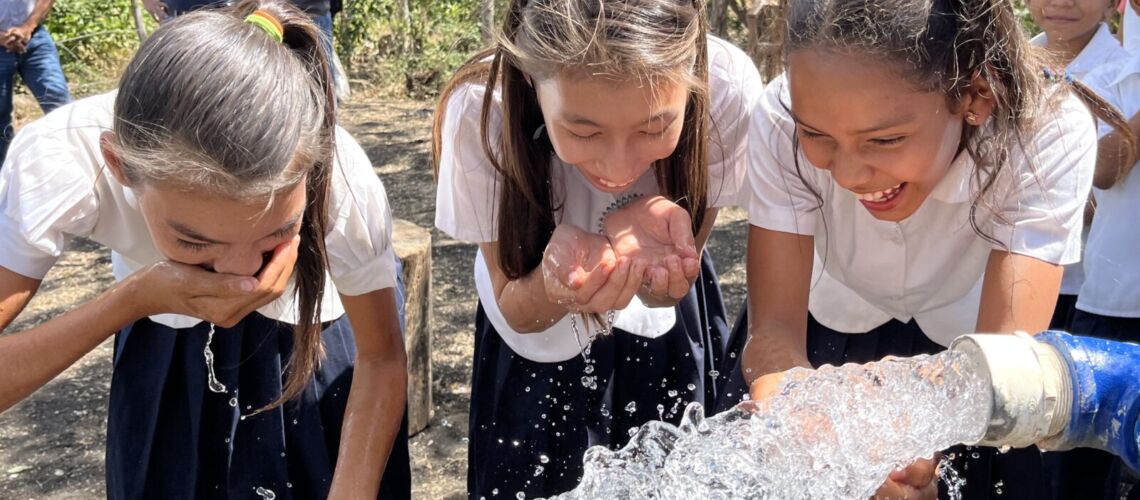
Water Flows Where Equality Grows
March 19, 2026
Twenty-two years ago, the Change for Children community was abuzz with the news that the Nicaragua Water Project had received support from the Government of Canada.
What followed was clean water access for more than 140,000 people across Nicaragua’s drought-stricken rural landscape.
The project went on to receive the United Nations Equator Prize for advancing innovative, sustainable solutions for resilient communities. It strengthened local leadership and supported rural women to step into active roles on their Community Water Committees. It reinforced the principle that decisions about the systems that sustain communities should be shaped by those who call them home.
It offered early proof that: where water flows, equality grows.
 Water well inauguration, Circa 2006
In Canada, the same project sparked something powerful.
Local students began to learn about the global water crisis. Grassroots fundraisers sprang into action. Young people championed water walks (see below) to raise awareness. Momentum spread across generations, organizing campaigns both big and small. From volcano climb challenges to airport hangar galas. From penny drives to bottle returns.
This project connected people across countries and showed countless individuals the power of collective action.
It provided tangible proof that: where water flows, equality grows.
 Little learners rally together, Circa 2021
The impact was water wells drilled, safe water access reaching homes and families, Community Water Committees opening bank accounts and managing their own systems, neighbours organizing to protect what had been built together.
And it was something else, too.
The quiet work of people in Nicaragua and in Canada alike choosing to care, organize, and act together.
As Change for Children nears 50 years of global impact, this project is one of many reminders that lasting change is built over years, across communities, and through relationships that continue to ripple outward.

Joy, Circa 2012
Now, more than two decades since the first water well was drilled, the ripple effects continue — in the communities who steward their water systems, and in the thousands of Canadians whose first introduction to global citizenship began with a simple question:
What if everyone had access to safe water?
The impact reached, and continues to reach, far beyond the water wells. Where water flows, equality grows.